








StoreFeeder WMS is fantastic for me and fantastic for my operations. The warehouse became paperless, and the number of orders processed per hour increased by 80%, overnight.



Pick waves go straight to each picker's PDA, phone or tablet. The handheld shows the next location on an optimised route, and every item is scanned and checked against the order before the picker moves on.

Each pick, booking-in, transfer and count updates stock the moment it is scanned, so the office and every sales channel see the same numbers as the warehouse floor. Nobody keys in paperwork at the end of the day.

The biggest saving from going paperless is rarely the paper. It comes from mistakes that never happen and admin that disappears: no printing and sorting pick lists, no typing in stock sheets, and fewer returns and reshipments from mis-picks.

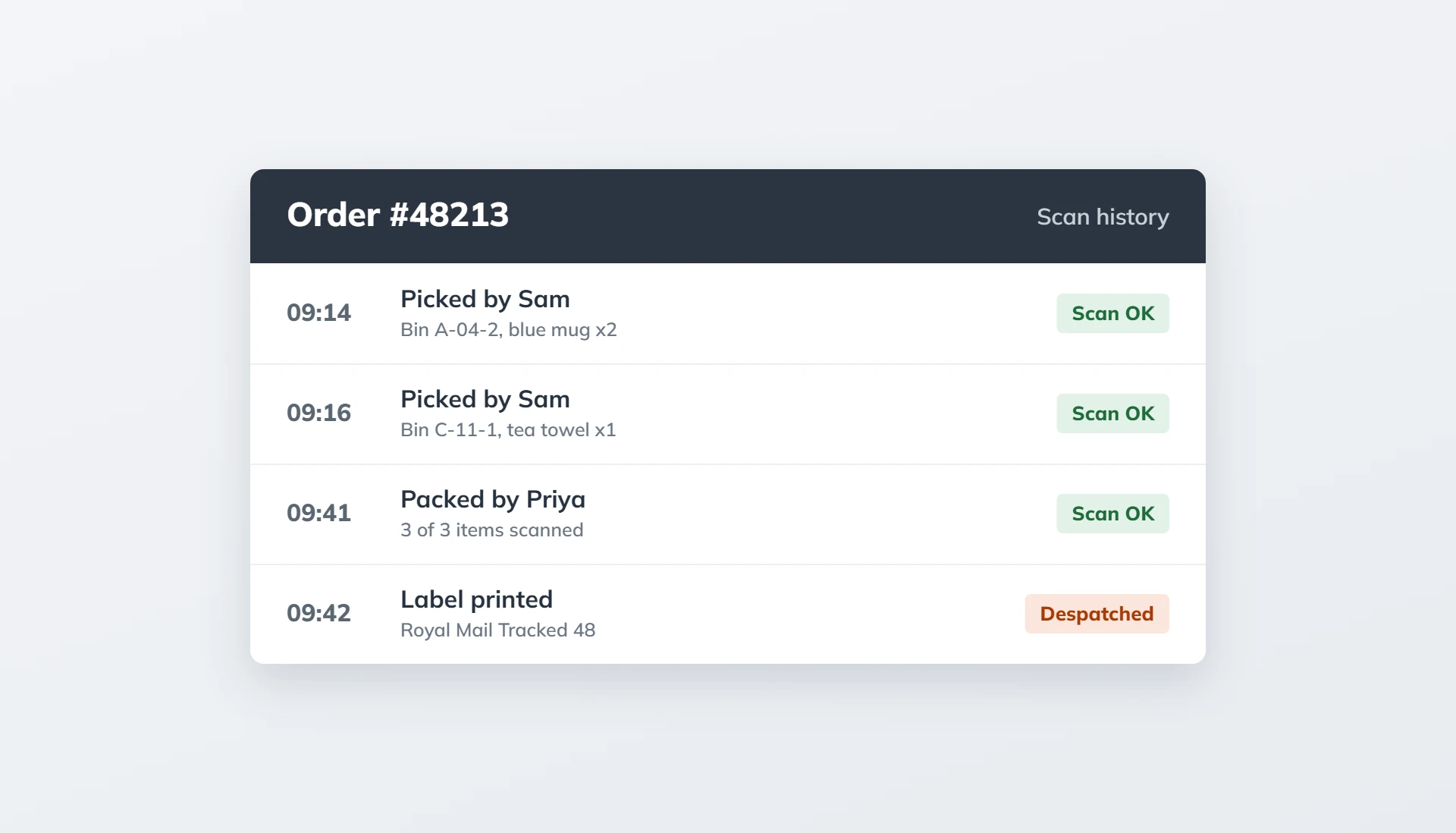
Every scan is timestamped against the person who made it. When a customer says an item was missing, you can see who picked and packed the order and what was scanned, instead of searching through paper.
Not ready for a demo? See what StoreFeeder could save you
Paperless picking replaces printed pick lists with a handheld device. Instead of reading a sheet and ticking items off, the picker follows the next task on a PDA, phone or tablet, scans the location and the product, and the system confirms the pick before they move on. The pick is recorded the moment it happens, so stock, order status and despatch all update without anyone keying in paperwork afterwards.
A paperless warehouse applies the same idea to everything else on the floor: booking in deliveries, putting stock away, moving it between locations, counting it and processing returns.
Orders from Amazon, eBay, Shopify, TikTok Shop and 40+ other channels are grouped into pick waves and sent to pickers' handhelds. The device shows the next location on an optimised route; the picker scans the location, then the product, and the pick is confirmed or rejected on the spot. You can run single order, batch, wave, zone or tote picking in different areas of the warehouse. See pick and pack software for the detail.
At the packing bench each item is scanned against the order, and the courier label prints once everything is checked. Tracking goes back to the sales channel automatically.
Deliveries are received against purchase orders on the same handheld and scanned into their locations, so new stock is available to sell as soon as it is put away. See warehouse booking in.
Moves between locations or warehouses, stock counts and returns are all done by scanning, so stock records stay accurate between full stock takes.
For typical hardware prices, see what a WMS really costs.
With a named implementation specialist, standard onboarding typically takes 3–6 weeks and a full warehouse go-live 6–12 weeks. See how implementation works.
StoreFeeder is built for UK eCommerce warehouses shipping from around 30 orders a day to several thousand, usually across more than one sales channel. If you are still printing pick lists, typing stock sheets into a spreadsheet or relying on experienced staff to know where everything is, going paperless is usually the biggest single improvement you can make. H2E Commerce went from 28 to 45 orders picked an hour after moving to scan-based picking.
Paperless working is part of StoreFeeder's warehouse management system and is included in every plan, from £350 a month ex VAT on rolling 30-day terms, with no per-user fees. There is a free trial with no card required. See pricing, work out your savings with the ROI calculator or book a demo.
Yes, and most warehouses do. A common order is to start with picking in one area, roll it out across the warehouse, then move booking in, stock transfers and counts onto the handhelds. Each step removes another paper process without disrupting the rest of the operation.
In StoreFeeder, paperless working is part of the warehouse management system and included in every plan, from £350 a month ex VAT on rolling 30-day terms, with no per-user or per-channel fees. The other cost is hardware: a handheld for each person on the floor and a label printer for each packing bench. There is a free trial with no card required. See pricing.
Paperless picking replaces printed pick lists with a handheld device. The picker sees the next location on screen, scans the location and the product, and the system confirms the pick or rejects a wrong item on the spot. Because each pick is recorded as it happens, stock and order status update straight away, with no paperwork to key in afterwards.
A paperless warehouse runs without printed pick lists, booking-in sheets or stock-count clipboards. Staff work from handheld devices that show the next task and check each step with a barcode scan, so picking, packing, booking in, stock moves and counts are all recorded as they happen. The result is fewer mistakes, live stock levels and far less admin.
A PDA, or an Android or iOS phone or tablet, for each person on the floor, barcodes on your products and locations, Wi-Fi coverage across the warehouse and a label printer at each packing bench. If your products are not barcoded yet, StoreFeeder can generate and print the barcodes. Speak to the team about recommended devices.
With a named implementation specialist, standard onboarding typically takes 3–6 weeks and a full warehouse go-live 6–12 weeks. The longest part is usually labelling locations and barcoding products. Once that is done, staff pick up the handheld quickly: new starters are typically picking in about five minutes. See how implementation works.
StoreFeeder suits UK eCommerce warehouses shipping around 30 or more orders a day, up to several thousand a day, usually across more than one sales channel. Below that, paperless picking still works but is harder to justify on cost unless each order is high value. Plans are priced on turnover, from £350 a month ex VAT, with no per-user fees, so adding handhelds and staff doesn't add software cost. See pricing.


Prefer to try it yourself? Start a 14-day free trial, no card required. We review each trial sign-up before setting up your account, so access isn't instant.
Start your free trial →