



































Your warehouse data is your most valuable business asset. Here's how to actually use it.
August 13, 2026
Here is a conversation I have had more times than I can count. A customer asks us to add a field to one of their reports, so we add it. A week or two later, a different customer using that same report asks why the field is suddenly there, since they have no use for it. Do that across every business we work with, and you land on a small, stubborn truth: there is no one report that suits everyone.
That used to frustrate me, but these days I think it points to something more useful: the shortage was never data. Your business generates plenty of data with every order, pick, stock movement and channel sale. The challenge is to present the right slice of data to the right person at the moment a decision needs to be made.
At StoreFeeder Sessions 2026, Shaun Field and I used our session to make that case in full: your data is one of the most valuable assets your business has, and the job now is to actually use it correctly. Here is what I mean by that and what we are building to make it easier.
Having the data was never the hard part
We have always taken the view that we host your data, but it is yours. For years, that meant solid import and export routines and a strong API, and we are still proud of how far that API goes. It is the baseline now. The harder and more useful question is the one we kept coming back to on stage: it is all very well having mountains of data, but doing something with it is what counts.
There is an old line I am fond of: "If it is not monitored, it doesn’t improve," and the same is true of a business. The numbers only matter if they change what you do next.
Logic beats opinion if you can see the data
I use a particular habit in meetings when opinions get strong, and in this industry they do. I ask a simple question: “How can you back that up?” followed by “Show me the data.” It takes the heat out of the room and puts the decision back on solid ground. Without the data, the loudest opinion tends to win, and that is rarely the same thing as the right call.
These days, the data matters more than it used to, and for one practical reason. AI is only as good as what you feed it. Connect a clever tool to stale or patchy data and you get confident answers that are still wrong. Feed it live, accurate data, and the same tool becomes genuinely useful. The data is the fuel and everything downstream depends on it.
What using your data actually looks like
Using your data well is not about staring at more numbers. It is about surfacing the signals that tell you something. These are a few we talked through:
- Profitability: by product and by channel, so you know what is making money rather than just turning over.
- Cash tied up in stock: because dead and slow-moving lines are working capital sitting on a shelf.
- Operational lag: the gap between an order landing and it leaving the building.
- Channel margins: so you can see where a marketplace's fees are eating the return.
- Stock health: the lines running low, and the ones you’re sitting on too much of.
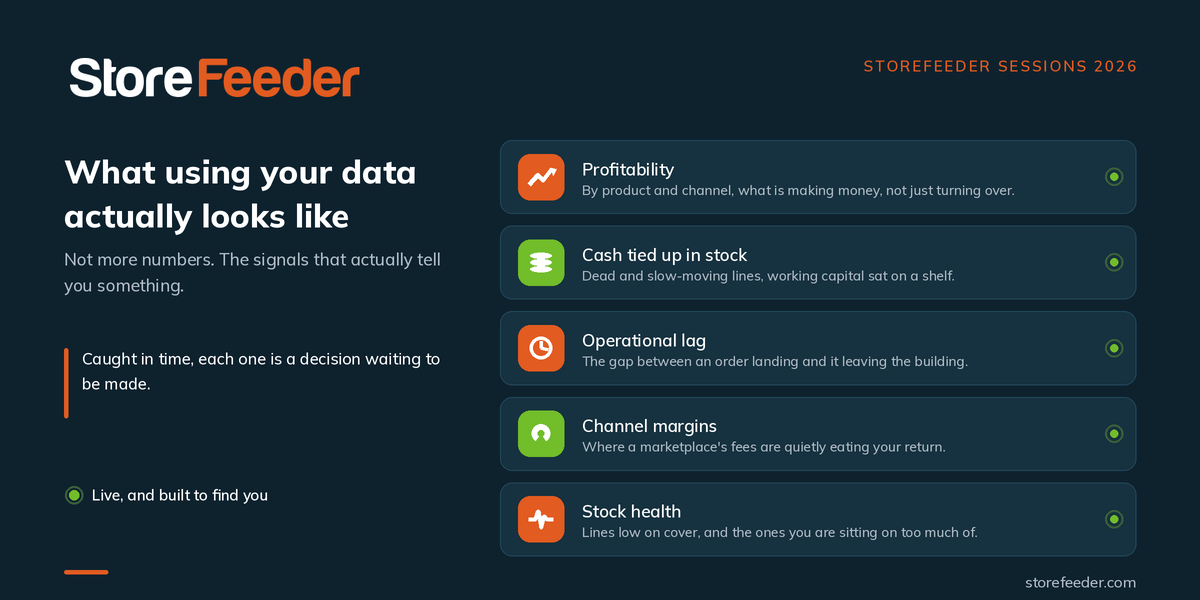
Caught in time, each is a decision waiting to be made; buried in a report nobody opens, they’re just numbers. And as I said at the top, a fixed report has the added problem of going out of date the moment you run it. The signals that matter need to be live, and they need to find you, not wait for you to dig them out.
We can't predict your questions, so we're handing you the tools
The conclusion we reached is that our job is not to guess every question you might ask. It is to give you the means to answer them yourself. So at Sessions, we previewed a set of new ways to get at and act on your data:
- Saved and scheduled reports: so the figures you check often arrive on a schedule instead of waiting to be pulled.
- Power BI access: for the teams that already live in it.
- The Reporting DB: a live copy of your data with a connection string, one of the most requested things we have ever been asked for, so you can plug your own tools straight in.
- AI-powered dashboard: live and tailored to your business, answer plain-English questions with a view rather than a spreadsheet.
- The MCP connector: a secure way to let an AI assistant work with your live StoreFeeder data.
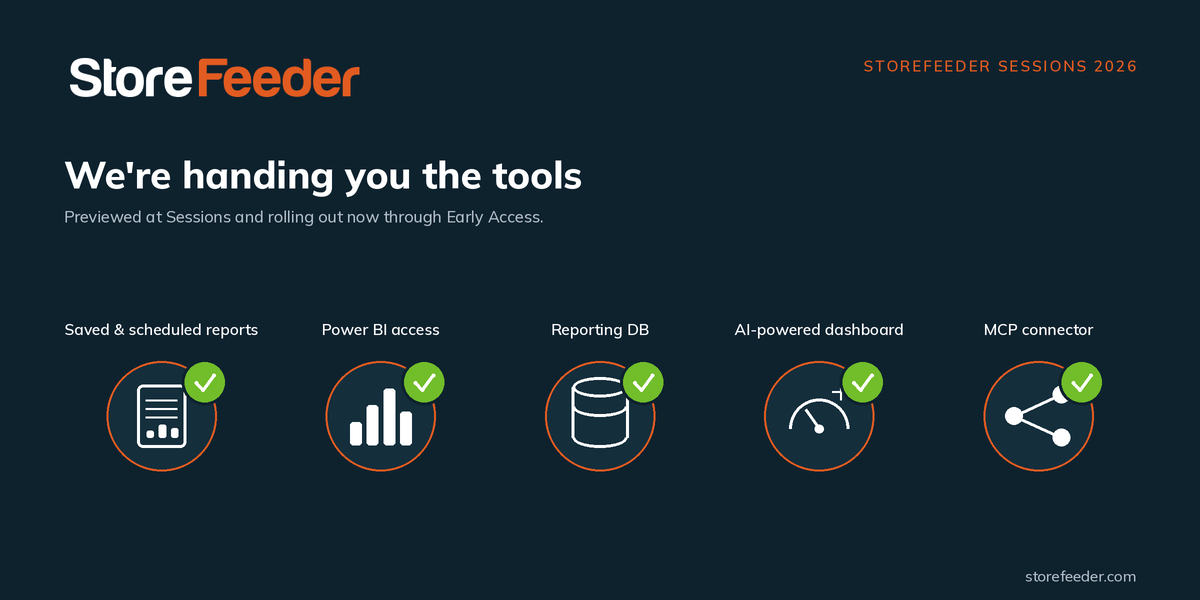
If you’re interested in the mechanics, we’ve done that in detail in our reporting tools deep dive, which is worth a read if you want to see how each one works. One thing to be clear about: most of this was previewed at Sessions and is rolling out through our Early Access Programme, so treat it as what is coming rather than what is live today. We will update you as each piece lands.
I will add one point of principle, because I’m not a fan of conferences that quickly turn into a price list. A good deal of this sits on your standard account – the scheduled reports, Power BI access, and the connector between them. The Reporting DB is the deeper layer for teams that want to build their own tooling on top. You can see exactly what sits where in our post on when the new features will be available.
From last quarter's spreadsheet to this morning
If there is one shift I would want you to take from the session, it’s this: stop running your business on last quarter's spreadsheet and start running it on what is happening today.
Your data is your most valuable asset, but only when it is in the right place at the right time, in front of the person making the call, and in the language they can act on.
That is what we are building towards, and it is why we keep asking customers what would help them. If you would like to see how StoreFeeder can turn your own data into decisions you can act on, book a demo and we will walk through your setup with you.
And if you missed Sessions or want to read more about the rest of the day, our Sessions 2026 recap pulls it all together.


