



































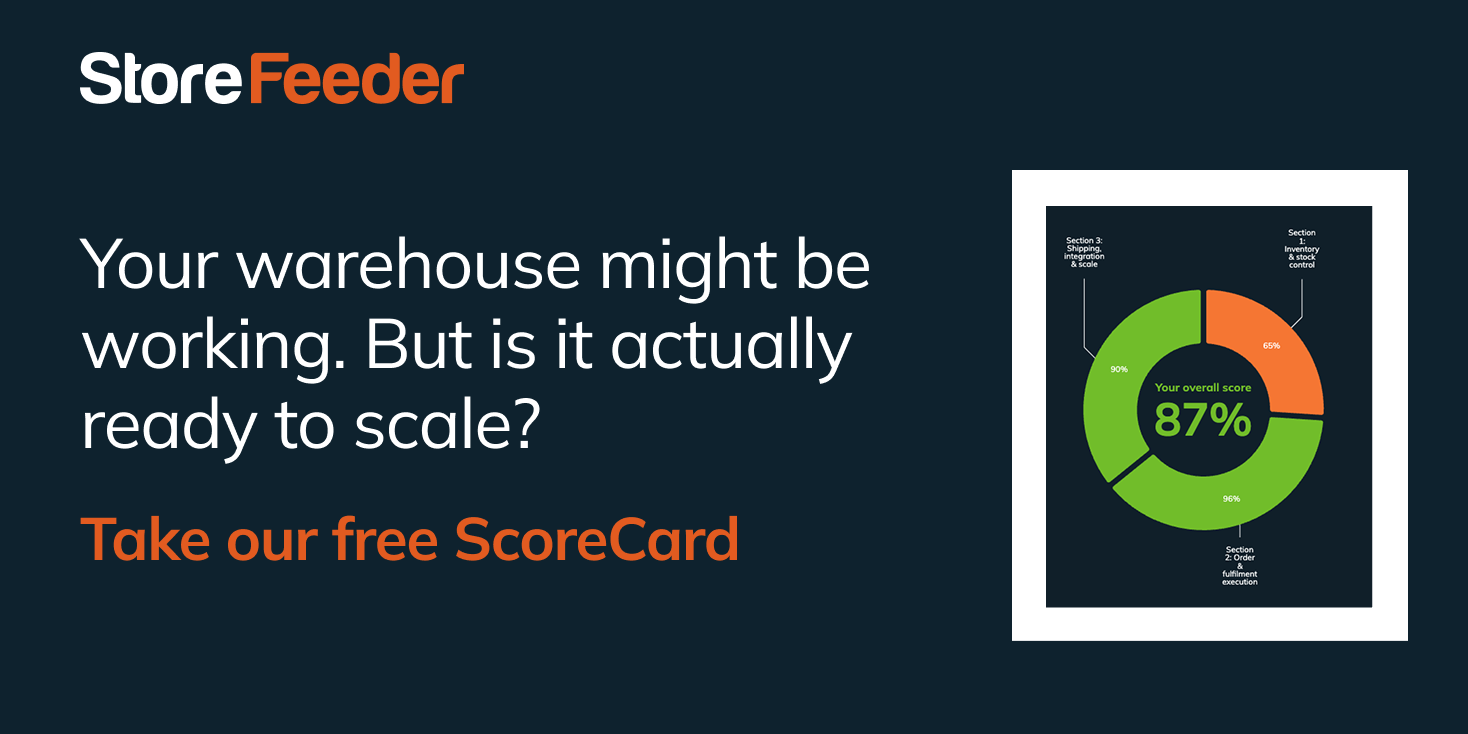
Your warehouse might be working. But is it actually ready to scale?
April 17, 2026
Running a modern eCommerce warehouse is a constant balancing act. Inventory has to stay accurate across multiple channels, orders need to move quickly, picking has to be precise, couriers have their own rules, and customers expect fast, flawless delivery every time. Most businesses are trying to hold all of that together with a mix of spreadsheets, legacy systems, and manual processes. It works, until it doesn’t.
That’s exactly why StoreFeeder has launched its new Warehouse Readiness Scorecard.
Why most warehouses hit a ceiling and don’t realise it
For many growing eCommerce businesses, the biggest risks aren’t obvious. They sit just below the surface. Stock might look accurate but isn’t properly synced across channels. Picking processes rely on memory or paper. Teams spend hours on tasks that should be automated. Entire operations depend on one or two key people. These aren’t just inefficiencies; they’re growth blockers.
From StoreFeeder’s customer insight, most businesses in the £2m to £20m range are already feeling this pressure. They’re dealing with fragmented systems, rising costs, and increasing complexity as order volumes grow. The problem is that many don’t have a clear way to assess where the gaps actually are.
Introducing the StoreFeeder warehouse readiness scorecard
The new scorecard is designed to answer one simple question: How ready is your warehouse to scale without breaking?
In just a few minutes, it gives you a structured view of your operations today, not based on guesswork, but on the factors that actually impact performance. You’ll get a clear view of your current readiness, insight into where inefficiencies or risks are creeping in, and practical next steps tailored to your results. It’s not just a checklist, it’s a diagnostic tool.
What the scorecard actually evaluates
The scorecard focuses on the areas that matter most when it comes to scaling warehouse operations effectively. It looks at how well your inventory is aligned across channels, which is critical for avoiding overselling and protecting customer experience. It assesses your picking and packing processes, particularly whether they are still manual or driven by systems and barcode validation. It highlights how much operational efficiency is being lost to repetitive manual work, and whether automation could unlock time and capacity. It also evaluates how dependent your warehouse is on individual knowledge, which creates risk as you scale. Finally, it considers how your operation performs under pressure, particularly during peak periods when small inefficiencies become major problems.
These are the exact areas where StoreFeeder typically sees businesses struggle before they make a change, particularly when moving from fragmented systems to a more integrated approach.
Why this matters more than ever
Warehouse complexity increases faster than most teams expect. What works at 100 orders per day quickly breaks at 500, and completely collapses at higher volumes. The shift isn’t gradual; it’s exponential.
That’s why StoreFeeder focuses so heavily on accuracy, efficiency, and system-led operations. The goal is to remove human error and replace guesswork with structured workflows and real-time data. By doing this, businesses can reduce returns, improve speed, and gain the visibility needed to make better decisions across the operation.
The scorecard is the first step in that journey.
From insight to action
The value of the scorecard isn’t just the score itself, it’s what you do with it. Based on your results, you’ll see where manual work can be reduced, where stock accuracy needs to improve, how fulfilment can be sped up, and where bottlenecks are likely to appear as you grow. It gives you a clear, practical starting point to improve your operations without needing a full transformation from day one.
This aligns with StoreFeeder’s broader approach, which is to move businesses from reactive, manual operations to structured, system-driven performance.
The hidden cost of doing nothing
Most warehouse inefficiencies don’t show up as one obvious issue. They appear as small daily delays, slightly higher error rates, gradual increases in cost, and frustrated teams and customers. Over time, these compound into significant operational drag.
Even small picking errors can lead to thousands in lost revenue over a year. Overselling damages customer trust and marketplace ratings. Manual admin quietly consumes hours that could be spent on growth. These are exactly the types of gaps the scorecard is designed to uncover before they become critical.
A simple way to pressure-test your operations
The best operators don’t wait for problems to become visible. They proactively assess where they are and where they need to improve. That’s what this scorecard enables. It gives warehouse managers, operations leaders, and eCommerce teams a fast and practical way to understand their current state without needing a full audit or system overhaul.
Take the warehouse readiness scorecard
If you’re running a growing eCommerce operation, this is the simplest place to start. In just a few minutes, you’ll understand whether your current setup can handle growth, where your biggest risks are, and what to fix first. Most importantly, you’ll know whether your warehouse is ready for what’s next.
Related reading
What would StoreFeeder cost for your business?
Answer a few quick questions about your orders and sales channels to see your monthly price. No obligation.
Check your price


