



































Peak period: the same sales growth, two very different warehouses
November 26, 2026
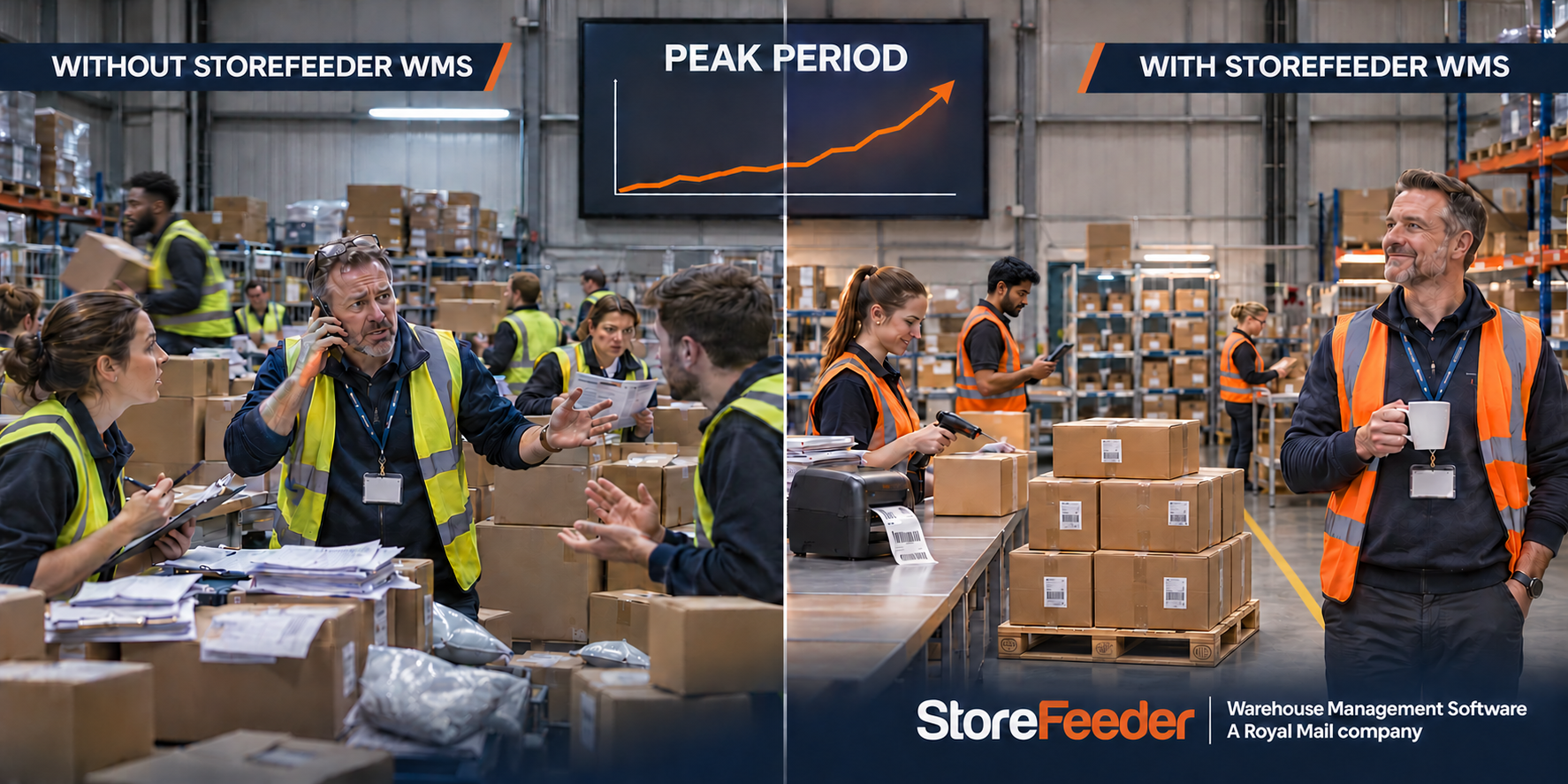
Imagine two warehouse managers looking at the same screen.
It says PEAK PERIOD, and the sales graph is climbing sharply.
For both businesses, that growth is good news. More orders should mean more revenue, more customers and a stronger end to the year.
However, what happens on the warehouse floor can be very different.
In one warehouse, boxes are accumulating, staff are waiting for instructions and the manager is trying to answer questions while checking courier cut-offs, marketplace deadlines and outstanding orders.
In the other, the warehouse is busy but controlled. Work is organised, staff know what to process next and the manager has time to oversee the operation rather than constantly firefighting.
The difference is not the number of orders. It is how the operation manages them.
Your warehouse can be coping without operating efficiently
A warehouse does not need to grind to a complete halt before there is a problem.
Orders may still leave the building, but achieving that result could require:
- Managers manually deciding which orders should be picked next
- Staff repeatedly asking what they should work on
- Overtime being used to recover lost time
- Marketplace orders being checked manually for approaching SLAs
- Packers correcting picking mistakes at the despatch bench
- Courier services and labels being selected individually
- Stock discrepancies being discovered only when somebody cannot find an item
- Experienced employees stepping in whenever an exception occurs
From the outside, the warehouse appears to be coping. The orders are being despatched and customers are receiving their parcels.
Behind the scenes, however, the operation is relying on additional effort, local knowledge and constant intervention from the warehouse manager.
That approach may survive an ordinary week. Peak exposes its limitations.
A dedicated eCommerce warehouse management system helps replace these manual decisions with consistent, system-led processes.
More orders create more decisions
When order volumes rise, the physical work is only part of the challenge.
The number of decisions also increases.
Which orders need to leave first? Which marketplace has the tightest SLA? Has the correct shipping service been selected? Is every item in the parcel? Which orders are waiting because of a stock issue? Will everything be ready before the courier arrives?
If these decisions depend on spreadsheets, paper lists or the warehouse manager’s memory, rising sales create an increasingly fragile operation.
The manager becomes the system.
Every question, exception and priority eventually reaches them. Instead of improving the operation, supporting the team or planning for tomorrow, they spend the day resolving problems created by today’s workload.
StoreFeeder organises the work around your priorities
StoreFeeder WMS helps turn incoming orders into a structured warehouse workflow.
Scheduled Pickwaves can organise orders using the rules and priorities that matter to the business. Rather than waiting for somebody to decide what should be released, work can be prepared around shift starts, courier cut-offs and different warehouse processes.
Orders can be prioritised according to factors such as their age, service requirements and operational importance. This helps the warehouse focus on the orders that need attention first, rather than simply working through the easiest or most visible pile.
Staff arrive knowing what they need to process. Managers retain control of the rules without having to control every individual action.
Protecting channel SLAs during peak
Selling through several marketplaces creates additional pressure because every channel may have different expectations.
An order that appears routine inside the warehouse could be approaching a marketplace deadline. If it is hidden among hundreds of other orders, the team may not realise it needs attention until it is already late.
StoreFeeder brings orders from different marketplaces and webstores into one system, helping the warehouse identify and prioritise urgent work.
Stock levels, order statuses and shipping updates can be managed centrally instead of teams moving between several channel portals throughout the day.
The objective is not simply to despatch more parcels. It is to despatch the right parcels at the right time, protecting channel performance and the customer promise while volumes are high.
Accuracy should not be sacrificed for speed
When the warehouse falls behind, the natural response is to work faster.
Without controlled processes, that can create more picking mistakes, incorrect parcels and avoidable returns. The time saved during picking is then lost at the packing bench, through customer service enquiries or when replacement orders must be sent.
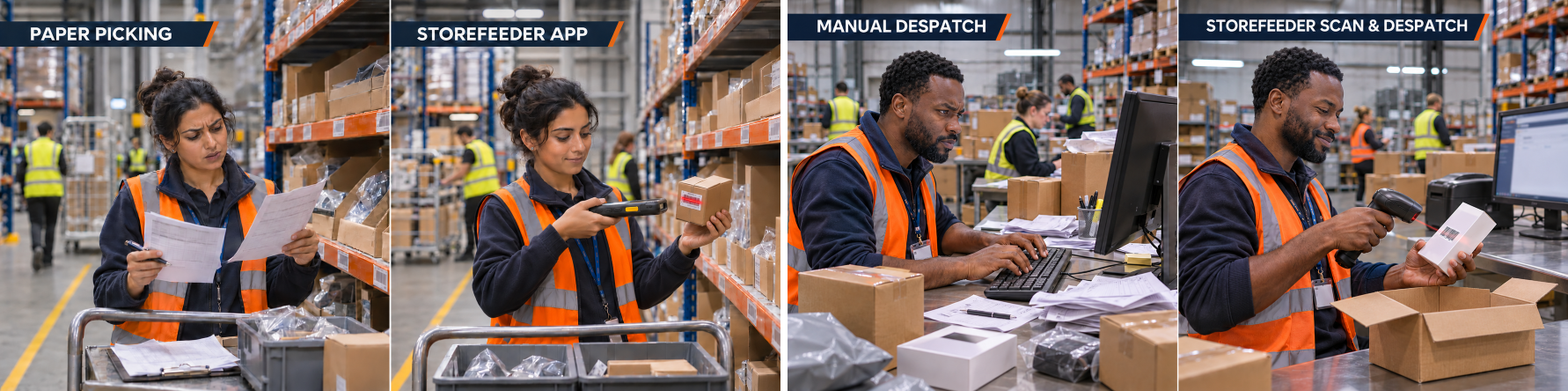
Barcode-led picking and packing allows StoreFeeder to validate products as they move through the warehouse.
The system can confirm whether the correct product has been scanned and guide the operator through the items required for an order. At despatch, the new Scan & Despatch workflow takes the process from the first barcode scan through to courier validation and the printed label.
This gives employees a consistent process to follow, including temporary staff brought in to support peak.
Accuracy becomes part of the workflow rather than something that depends entirely on an individual remembering every detail.
Automating the steps after packing
Packing the box is not the final part of despatch.
The correct courier and service still need to be selected, labels and documents must be produced, tracking information needs to be recorded and the sales channel must be updated.
Handling these steps manually adds time to every order and creates another opportunity for inconsistency.
StoreFeeder’s shipping management tools can use predefined rules to help select the appropriate courier service, produce the required label and return tracking information to the relevant sales channel.
StoreFeeder also connects with marketplaces, webstores, couriers and other ecommerce platforms, reducing the need to re-enter information across separate systems.
Saving a few moments on one parcel may not appear significant. Applied across hundreds or thousands of peak orders, it can return valuable hours to the operation.
The manager should manage the operation, not every order
A well-run warehouse can still be extremely busy during peak.
StoreFeeder does not remove the need for experienced managers or capable warehouse teams. It gives those people clearer processes, better information and more control over how the work is completed.
The result should not be a warehouse in which nothing ever goes wrong. Exceptions will always occur.
The difference is that an exception becomes something the manager can investigate, rather than the entire operation depending on the manager to keep it moving.
That creates time to monitor performance, support employees, resolve genuine problems and prepare for what is coming next.
Perhaps even time for a cup of coffee while it is still warm.

Could your warehouse handle further growth?
The real test of a warehouse is not whether it can get through today’s orders somehow.
It is whether it can process more orders without requiring the same increase in people, overtime, manual decisions and management intervention.
If a rising sales graph immediately means more paperwork, more firefighting and more pressure, the warehouse may be placing a limit on the growth of the wider business.
StoreFeeder WMS helps ecommerce retailers bring their channels, stock, orders, picking, packing, courier connections and reporting into one controlled system.
If you would like to see how StoreFeeder could help your warehouse move from peak-period firefighting to a more organised and scalable operation, book a free StoreFeeder demonstration.
Still running your warehouse on spreadsheets or paper pick lists? See how StoreFeeder's warehouse management system runs goods-in, picking, packing and despatch in one place →Or work out what it could save you with the ROI calculator →Book a demo


