




































Six forces reshaping UK eCommerce right now, and what retailers should do about them
September 2, 2026
Every retailer knows the market is changing, but far fewer get a clear answer on what is actually driving that change.
At StoreFeeder Sessions 2026, Jon Reeves gave the audience a straight answer. As Head of Channels and Strategic Partnerships at Royal Mail, he has been with the business for thirty years – long enough to have looked after the big mail-order catalogues in their heyday: order on paper, wait 28 days, and pay later. His view is that the last two years have brought the fastest change the industry has seen, in the shape of the market as much as in the technology.
He set out six forces driving that change. Here is what they are and what each one means for a UK eCommerce operation. You can watch Jon's full session here.
The six forces
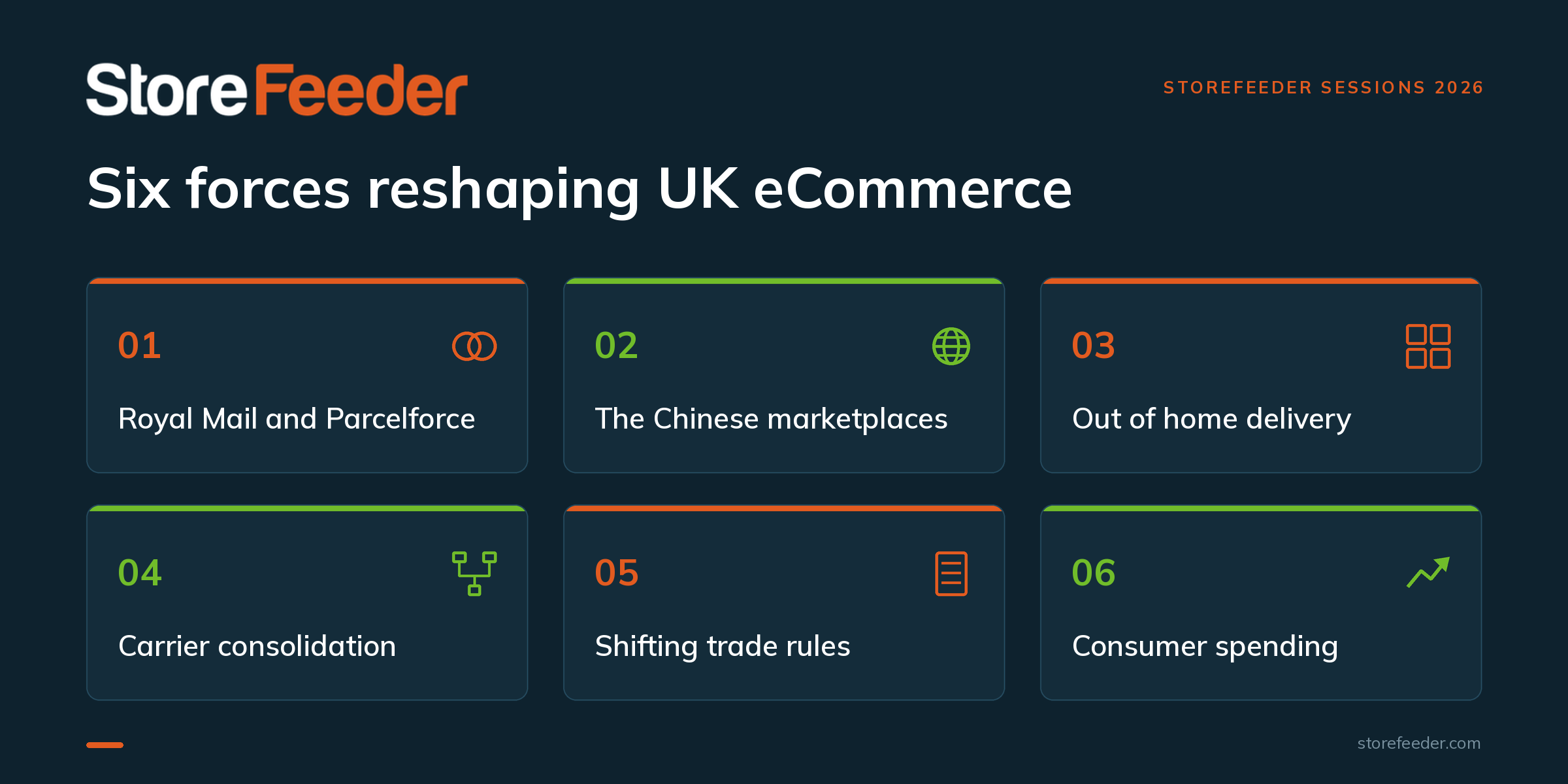
1. Royal Mail and Parcelforce are becoming one network
Until recently, the two ran as separate businesses with separate IT platforms, sales teams and service ranges. Over the past year, they have moved to a single platform and a single sales operation, so one relationship now covers everything from a letter to a 30kg parcel.
Parcels can move between the two networks. Jon described the principle as putting the right parcel into the right network, so a bulky item goes into the Parcelforce network rather than onto a postal worker's round. Features that existed on only one side are being brought across to the other, and building on one platform instead of two is intended to reduce costs.
For retailers, that means more service choice from a single account and a carrier working hard on the cost base that sits inside your margin. Deliveries still run as two operations behind the scenes, but you are only dealing with one.
2. The Chinese marketplaces are resetting price expectations
Shein, TikTok Shop and Temu have grown at a pace that few predicted. Jon estimates that between 20% and 30% of UK parcel volume is now driven by Chinese companies selling to UK consumers, and the effect has been to push prices down across the board.
Two names have not yet made a serious move in the UK: AliExpress and JD.com, and Jon expects that to change. Consolidation is happening on the seller side too: marketplaces and aggregators keep gathering volume, Vinted has grown enormously, and platforms such as Shopify are moving towards offering fulfilment on sellers' behalf.
The implication is uncomfortable but clear: competing on price alone against that cost base is not a strategy. Speed, accuracy and a returns experience people trust are where a UK retailer really wins.
3. Out-of-home delivery is becoming the expectation, not the alternative
Across Europe, delivery to lockers, parcel shops and pickup points has shifted from a fallback to a first choice, and Jon sees the same pattern arriving in the UK, led by younger buyers. This trend applies to both outbound delivery and returns.
Royal Mail is investing accordingly. There are now over 8,500 Royal Mail parcel shops, and the plan is to reach around 7,000 lockers by the end of March 2027, with partnerships including Sainsbury's, Tesco, Co-op and Transport for London. Post boxes are being modernised for the first time in roughly 175 years, with parcel apertures, solar power, scanning and proof of posting, which matters for returns and for smaller sellers posting outside working hours. The competition is fierce, as Jon put it: InPost, Amazon, Evri and everyone else are racing for the same space on the same high streets.
4. The carrier market is consolidating
The list of moves is long. Evri and DHL's UK parcel operation have come together, with Evri Premium launched off the back of it. InPost has bought Yodel. FedEx has taken a substantial stake in the InPost group. On Royal Mail's own side, EP Group completed its takeover in April 2025, bringing new commercial leadership and a restructure into business parcels, consumer parcels and out-of-home. USO reform is rolling out alongside it, which should lift letter service quality while freeing the network to handle eCommerce fulfilment more effectively.
Jon's read on all of it was refreshingly unbothered. Consolidation drives competition, competition drives innovation, and it forces every carrier, his own included, to ask how well it actually serves its customers.
5. The trade rules have moved, and they are still moving
The removal of the US de minimis threshold hit hard. Jon was blunt: it decimated export volumes until sellers could access delivered duty-paid solutions.
At Sessions in May, he expected the EU's small-parcel measure to follow in July, if member states were ready. It arrived. Since 1 July 2026, a flat €3 customs duty applies per item category on consignments under €150 entering the EU, an interim arrangement until normal tariffs take over. We covered the detail in our post on the EU customs changes.
Royal Mail's response has been to widen its international range: parcels up to 30kg, more tracked and delivered duty-paid destinations, a landed cost calculator covering taxes and duties before you ship, and better reporting. The wider point for retailers is that accurate HS codes on your customs declarations are now a commercial issue rather than an admin one.
6. Consumer spending is shifting in ways nobody forecast
A weak economy, along with high energy, fuel, and household costs, is squeezing discretionary spending, forcing consumers to choose between quality and price. Sustainability expectations continue to rise for both retailers and carriers.
Then came the point that nobody in the room saw coming. The weight loss drug market has exploded, and Jon traced the knock-on effects: people are eating out less, which has hit restaurant volumes, while clothing sales have risen as customers lose weight and buy new wardrobes. It is a useful reminder that demand in your category can move sharply for reasons that have nothing to do with your category.
What to actually do about it
No single retailer can influence these forces, but all of them can prepare for them.
- Keep your carrier options open. With ownership and pricing shifting this quickly, being able to add a carrier or switch a service by rule rather than by rebuild is worth more than any single rate card. StoreFeeder integrates with over twenty couriers, and courier management rules allocate every order to the right service automatically.
- Treat out-of-home as a proper option. If lockers and parcel shops are where customers increasingly want deliveries and returns, those services belong at checkout rather than buried.
- Get your product data right. HS codes, weights, dimensions and country of origin all carry a price when they are wrong.
- Watch your numbers, not the headlines. Macro trends are averages. What matters are your channels, categories and margins.
Jon's closing thought applies well beyond Royal Mail. Anyone can move a parcel from A to B – it’s how you do it that makes the difference.
To see how StoreFeeder helps you stay flexible as the market keeps moving, book a demo and we will walk through your setup with you.


