


































From listing to live in seconds: How StoreFeeder is using AI to eliminate the manual grind of multi-channel selling
August 20, 2026
Getting a product live used to be the quick part of selling, but now it can be one of the slowest. Every marketplace wants more from you: Amazon keeps adding required attributes that are awkward to fill in, eBay rewards listings that have every item specific completed, and there is a growing layer of compliance and regulatory data on top. Multiply that across hundreds of SKUs and several channels, and a job that should take minutes becomes hours of copying, checking and re-keying.
At StoreFeeder Sessions 2026, Brian Williamson and Shaun Field demonstrated the AI tools we have built to take that work off your plate while keeping you in the driving seat. This post covers two of them: the new AI listing creation workflow and the StoreFeeder MCP connector, which lets an AI assistant work directly with your live data.
Most of what follows in this article was demonstrated on stage at Sessions rather than switched on that day. These listing and connector tools are rolling out through our Early Access Programme over the coming weeks and months, and some are still in active development, so treat this release as a look at what is coming rather than a set of features to go and use today. For what is live right now and which package each one sits in, see our post on when the new StoreFeeder features will be available. We will flag each tool here on the blog and in your usual StoreFeeder updates as it goes live, so it is worth keeping an eye out.
Create a listing without building the product first
Until now, listing a product meant creating the product record first, then the listing. The new workflow changes this: from the listing grid, you will be able to click to create a new listing, choose a channel and go straight to a listing, with StoreFeeder building the product record in the background.
In the demo, Shaun created an eBay listing for a Spider-Man t-shirt: red, large, with a SKU, a category and nothing else. Because it was a brand new eBay listing, StoreFeeder asked whether to use eBay's AI catalogue, an API eBay has released, to fill in the details. One click, and it looked the product up against eBay's catalogue, found the best category, and populated the item specifics, colour set to red, size to large, and the rest – the fields that decide whether a listing gets found and converts.
Amazon will work the same way, using StoreFeeder's own AI tool rather than eBay's. Amazon has piled on properties that are difficult to complete by hand. The tool reads the product's existing details, its description and item specifics, and fills in as much as it can: age, gender, category, model number, manufacturer, occasion and description. What was a careful ten minutes per listing is now a quick review.
That last word matters because this is human-in-the-loop AI. It does the heavy lifting, but you check it before anything goes live. The aim is not to take the decision away from you but to reduce your manual administration.
Fix what is already live in bulk
Creating new listings well is only half the job. The other half is fixing the existing listings that have gaps. You saw the eBay listing health view in our reporting tools deep dive: it shows exactly which listings are missing item specifics and which fields are blank. The natural next step is to fix them without working through each one by hand.
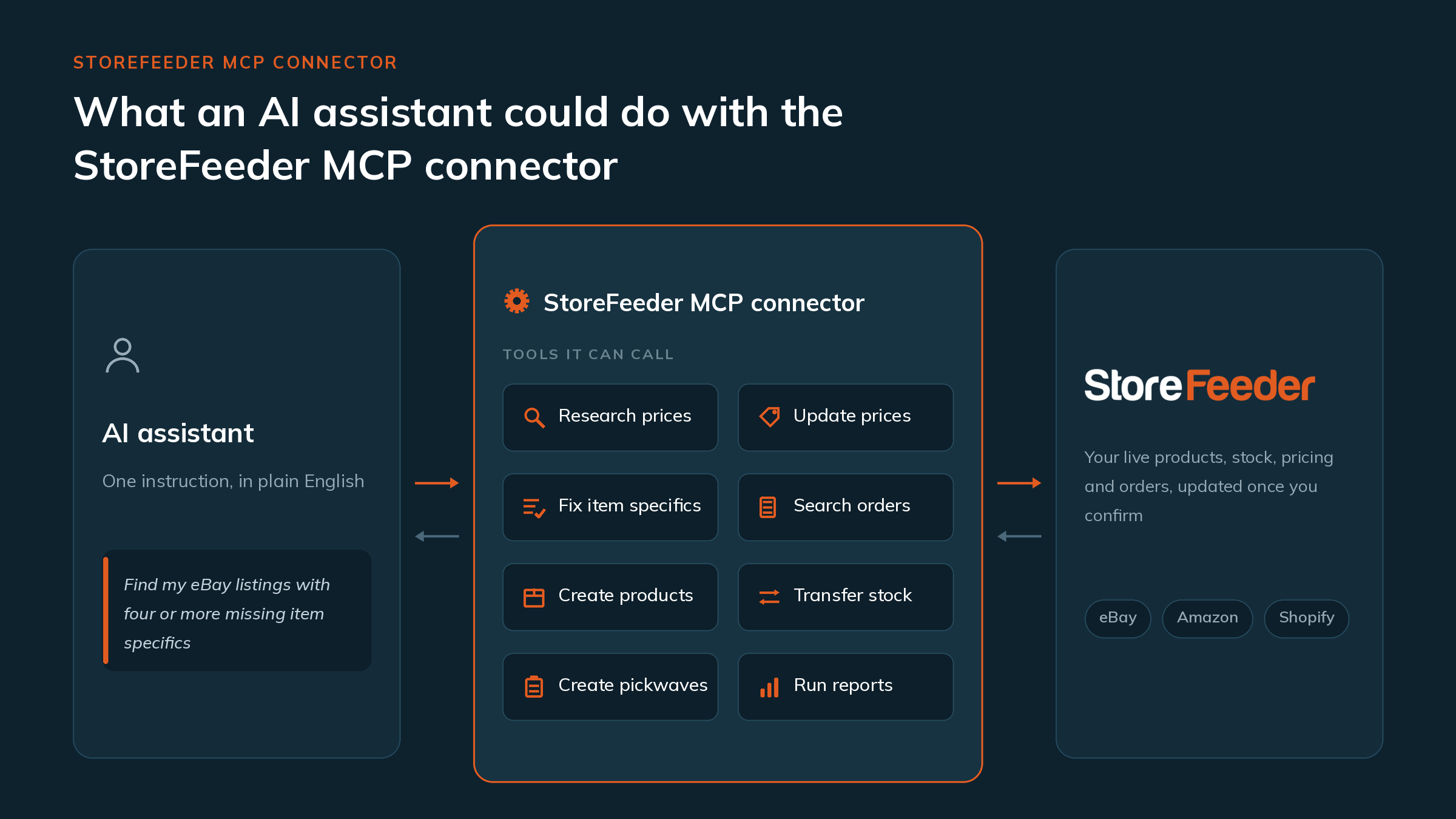
That is where the StoreFeeder MCP connector comes in. MCP is an open standard for connecting AI assistants such as Claude or ChatGPT securely to live data. With StoreFeeder connected, the idea is that you give an instruction in plain English, for example, 'Find my eBay listings with four or more missing item specifics', and have the assistant suggest the fixes and apply them, checking with you as it goes. Bulk fixing missing item specifics this way is what we are building next, and it turns the listing health dashboard from a to-do list into something close to done.
Research a price, then act on it
The connector is not limited to listings. The tools behind it can also search orders, run reports, create products and pickwaves, transfer stock and update prices. Pricing was one of the clearest demos of the day.
Connected to live data, the assistant was asked to research what a product was selling for elsewhere. It pulled together a comparison of competitor prices, around £4.65 in most places and £4.20 on eBay, and could chart it. Then came the useful question: what is the best price to sell the item at to stay competitive and still make a decent margin? Working from the cost price and current pricing, it recommended a price of £4.49, but the instruction to update the price was not carried out automatically. The assistant asked whether the operator really wanted to do that, and only went ahead once they confirmed. The price moved from £5.50 to £4.49, and any linked pricing profile updated the live listing accordingly.
It can also go a step further and suggest products to add. Ask it to look up your top twenty best-sellers and find twenty alternatives, and it can research similar products and create them in StoreFeeder, ready for you to list across your channels.
Powerful tools, with the guardrails to match
Handing an AI assistant the ability to change prices and create products can be daunting for most, so it is built to be careful. As Brian said on stage, this capability is very powerful, and the wrong prompt left unattended can cause damage, but we've put practical protections in place:
- It confirms before it writes: anything that changes your data asks permission first, exactly as the repricing demo showed.
- Everything is logged: you get a full audit trail, and you set the policy and limits per user.
- Your data stays yours: it is used only to answer your request, never to train third-party models, as long as you are on the right AI tier. An enterprise ChatGPT plan keeps your data in your environment; a free one may not, so this is worth setting up correctly.
There is a reason for the caution. The industry has seen repricing go wrong, with products dropping below cost and rolling out automatically, along with other real-life horror stories. StoreFeeder's approach is the opposite of fire-and-forget: the system researches and recommends, but you always confirm.
The takeaway
The thread running through it all is the point Brian kept returning to: the goal is not for AI to run your business while you’re not looking. It is to use AI to do the slow, repetitive work, like finding the right item specifics, researching a fair price and drafting the listing. You get all the hours back, but you get to keep the judgement and make the final call.
These AI listing and connector features are rolling out via our Early Access Programme. For what is live now and which package each one sits in, see our post on when the new StoreFeeder features will be available .


